
SudokuPublished Mar 6, 2026Updated Sep 27, 202612 min read
Sudoku Tips for Beginners: How to Solve
Create sudoku— free, no account, PDF + answer key



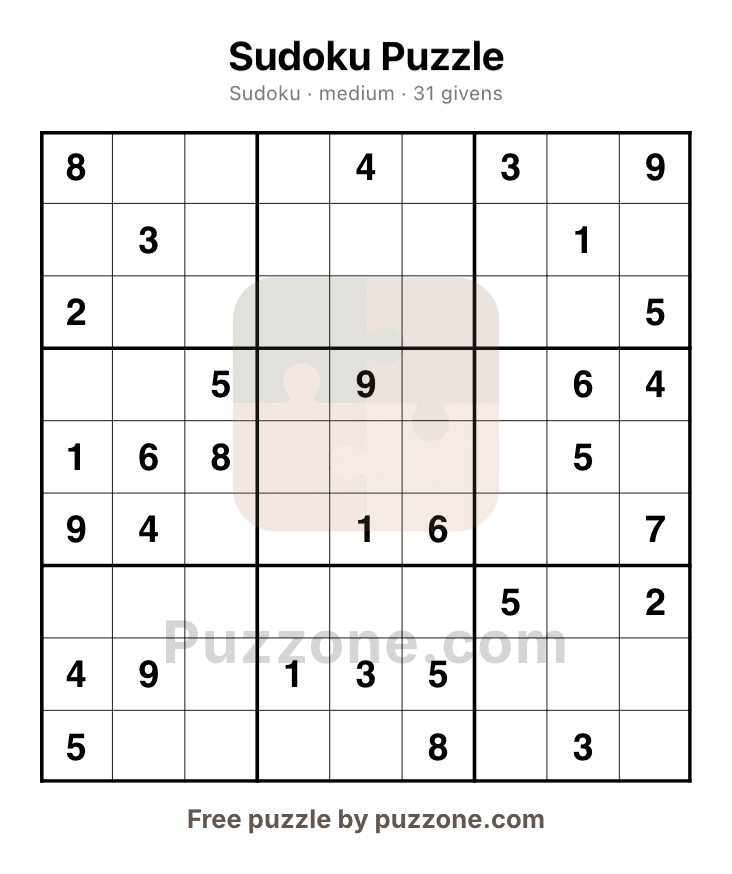
What is sudoku and how does it work?
Sudoku is a logic-based number-placement puzzle played on a 9×9 grid divided into nine 3×3 boxes. The goal is to fill every empty cell with a digit from 1 to 9 so that every row, every column, and every 3×3 box contains all digits from 1 to 9 exactly once. No arithmetic is required — sudoku is pure deduction.
The modern form of sudoku was popularized in Japan in the 1980s (the name means "single number"), but the underlying idea traces back to Swiss mathematician Leonhard Euler's 18th-century "Latin squares." Today an estimated 100 million people play sudoku worldwide, across newspapers, apps, and free printable sudoku generators like Puzzone — which works as a sudoku puzzle generator with answers and a built-in sudoku for seniors large-print mode. If you can count to nine, you can play.
This is a complete sudoku tips for beginners guide: how to solve sudoku step by step using the four foundational sudoku strategies (naked singles, hidden singles, cross-hatching, candidate marking) and a roadmap for moving on to advanced sudoku techniques like X-Wing and Swordfish once you outgrow easy and medium grids.
The modern form of sudoku was popularized in Japan in the 1980s (the name means "single number"), but the underlying idea traces back to Swiss mathematician Leonhard Euler's 18th-century "Latin squares." Today an estimated 100 million people play sudoku worldwide, across newspapers, apps, and free printable sudoku generators like Puzzone — which works as a sudoku puzzle generator with answers and a built-in sudoku for seniors large-print mode. If you can count to nine, you can play.
This is a complete sudoku tips for beginners guide: how to solve sudoku step by step using the four foundational sudoku strategies (naked singles, hidden singles, cross-hatching, candidate marking) and a roadmap for moving on to advanced sudoku techniques like X-Wing and Swordfish once you outgrow easy and medium grids.
What are the rules of sudoku?
Sudoku has only three rules, and every solving technique in the world is built from them:
A valid sudoku puzzle has exactly one solution. That is important: if you ever reach a point where you must guess, you are either missing a technique or the puzzle was poorly constructed. A well-made puzzle is always solvable through pure logic. Good sudoku generators verify uniqueness before publishing, which is why the puzzles on Puzzone are always single-solution.
- Each row must contain the digits 1-9 with no repeats.
- Each column must contain the digits 1-9 with no repeats.
- Each 3×3 box must contain the digits 1-9 with no repeats.
A valid sudoku puzzle has exactly one solution. That is important: if you ever reach a point where you must guess, you are either missing a technique or the puzzle was poorly constructed. A well-made puzzle is always solvable through pure logic. Good sudoku generators verify uniqueness before publishing, which is why the puzzles on Puzzone are always single-solution.
How do I solve sudoku as a beginner?
Sudoku for beginners is mostly a mindset shift, not a memorized technique list. The beginner's mindset is: never guess, never erase. Every digit you write should be forced by the rules, not a hunch. Start with the easiest technique (naked singles), move to hidden singles, and only reach for candidate marking when the simple passes stop yielding results.
A good rhythm for sudoku for beginners looks like this: scan the full grid for "obvious" placements first, make all of them, then scan again because new placements usually unlock more. When both passes yield nothing, upgrade to pencil marks. The entire puzzle is solvable with just four techniques — naked singles, hidden singles, naked pairs, and pointing pairs. You do not need advanced tactics like X-Wing or Swordfish for easy or medium difficulty. Those are only needed at expert difficulty.
For seniors who want a senior-accessible experience, large print sudoku for elderly solvers is available at our large-print puzzles page — same beginner techniques, just bigger numbers and more white space.
A good rhythm for sudoku for beginners looks like this: scan the full grid for "obvious" placements first, make all of them, then scan again because new placements usually unlock more. When both passes yield nothing, upgrade to pencil marks. The entire puzzle is solvable with just four techniques — naked singles, hidden singles, naked pairs, and pointing pairs. You do not need advanced tactics like X-Wing or Swordfish for easy or medium difficulty. Those are only needed at expert difficulty.
For seniors who want a senior-accessible experience, large print sudoku for elderly solvers is available at our large-print puzzles page — same beginner techniques, just bigger numbers and more white space.
How do I find naked singles?
A naked single is the simplest sudoku pattern. Pick an empty cell and ask: given the digits already in its row, column, and box, how many digits are still legal here? If the answer is "only one," that digit goes in the cell.
Example: suppose the row contains 1, 2, 3, 5, 6, 7, 8, and 9, and the column contains 4. Only the digit 4 is missing from the row — but 4 is already in the column, so the cell cannot be 4 either. Something is wrong with this scenario (contradiction). In a valid puzzle, a naked single cell will have exactly one digit that is legal across all three constraint groups.
Search every empty cell this way on your first pass. Naked singles are the easiest wins and often trigger a chain — placing one digit creates more naked singles elsewhere on the board.
Example: suppose the row contains 1, 2, 3, 5, 6, 7, 8, and 9, and the column contains 4. Only the digit 4 is missing from the row — but 4 is already in the column, so the cell cannot be 4 either. Something is wrong with this scenario (contradiction). In a valid puzzle, a naked single cell will have exactly one digit that is legal across all three constraint groups.
Search every empty cell this way on your first pass. Naked singles are the easiest wins and often trigger a chain — placing one digit creates more naked singles elsewhere on the board.
How do I find hidden singles?
A hidden single flips the question around. Instead of asking "what can go in this cell?", ask "where in this row/column/box can the digit N go?"
Pick a row. Pick a digit (say, 7). Check each empty cell in that row — can 7 legally go there? If only one cell accepts a 7, that cell must be 7, even if other digits could also fit there. The 7 is "hidden" because the cell has multiple candidates, but the row forces the placement.
Hidden singles are harder for humans to spot because you are looking for negative evidence (all other cells are blocked). A useful trick: focus on one digit at a time across the whole grid. Sweep all rows for hidden 1s, then all columns for hidden 1s, then all boxes. Then move to digit 2. This systematic approach catches placements that random scanning misses.
Pick a row. Pick a digit (say, 7). Check each empty cell in that row — can 7 legally go there? If only one cell accepts a 7, that cell must be 7, even if other digits could also fit there. The 7 is "hidden" because the cell has multiple candidates, but the row forces the placement.
Hidden singles are harder for humans to spot because you are looking for negative evidence (all other cells are blocked). A useful trick: focus on one digit at a time across the whole grid. Sweep all rows for hidden 1s, then all columns for hidden 1s, then all boxes. Then move to digit 2. This systematic approach catches placements that random scanning misses.
What is cross-hatching or scanning?
Cross-hatching is the technique of using multiple constraint groups at once to pin down a digit's location. It is how you find hidden singles efficiently.
Here is the drill: pick a digit, say 5. Find every row and column that already contains a 5. Those entire rows and columns are now "blocked" for 5s. Now look at a 3×3 box that does not yet contain a 5 — the blocked rows and columns will eliminate most cells in that box, often leaving just one legal square. That is where 5 must go.
Cross-hatching is especially powerful in the first 5-10 minutes of a puzzle, when many digits already appear 2-3 times on the grid. Each digit already placed 5 or more times can usually be fully resolved just through cross-hatching. Develop this habit and easy puzzles will solve themselves in under 3 minutes.
Here is the drill: pick a digit, say 5. Find every row and column that already contains a 5. Those entire rows and columns are now "blocked" for 5s. Now look at a 3×3 box that does not yet contain a 5 — the blocked rows and columns will eliminate most cells in that box, often leaving just one legal square. That is where 5 must go.
Cross-hatching is especially powerful in the first 5-10 minutes of a puzzle, when many digits already appear 2-3 times on the grid. Each digit already placed 5 or more times can usually be fully resolved just through cross-hatching. Develop this habit and easy puzzles will solve themselves in under 3 minutes.
How do candidate marks (pencil marks) work?
When scanning and cross-hatching stop producing placements, switch to candidate marking. For each empty cell, write small digits in the corner showing which numbers are still legally possible there. This is sometimes called "pencil marking" because sudoku solvers traditionally used a pencil to add and erase candidates.
Use candidates to spot higher-order patterns:
Candidates let you see the puzzle's structure, not just its surface.
Use candidates to spot higher-order patterns:
- Naked pair — two cells in the same row, column, or box that both have exactly the same two candidates. Those two digits must occupy those two cells, so they can be eliminated from every other cell in that group.
- Hidden pair — two digits that only appear as candidates in the same two cells within a group. Those cells must contain those two digits; all other candidates in those two cells can be erased.
- Pointing pair — when a digit's candidates in a 3×3 box all sit in the same row (or column), that digit can be eliminated from the rest of the row/column outside the box.
Candidates let you see the puzzle's structure, not just its surface.
What are the most common beginner mistakes?
Watch out for these five traps:
Every mistake above shows up in roughly 80% of beginner solves, so fixing them is the fastest way to level up.
- Guessing. If you feel like guessing, you are missing a technique. Go back and look harder — especially for hidden singles, which are easy to overlook.
- Ignoring the 3×3 box. Beginners tend to check only rows and columns. The box constraint is just as powerful and often the key to cross-hatching wins.
- Writing too many candidates. Only add pencil marks once simple scanning has stalled. Marking candidates in every cell from the start creates visual noise and slows you down.
- Skipping the recount. After placing any digit, rescan the row, column, and box it sits in — your placement may have created a new naked or hidden single.
- Playing tired. Sudoku rewards focus. A 10-minute rest mid-puzzle often lets your brain spot the pattern you missed.
Every mistake above shows up in roughly 80% of beginner solves, so fixing them is the fastest way to level up.
Is sudoku good for your brain?
Evidence from multiple neuropsychology studies suggests yes — though not in the miraculous "prevents dementia" sense often claimed in advertising. Sudoku exercises working memory, pattern recognition, and focused attention, and regular puzzlers perform better on some short-term cognitive tasks than non-puzzlers.
A 2019 study from the University of Exeter, following over 19,000 adults aged 50-93, found that frequent puzzle-solvers (including sudoku and crosswords) had sharper short-term memory and attention equivalent to being 8-10 years younger on some tests. What sudoku does not do is improve unrelated skills — doing sudoku makes you better at sudoku, and moderately better at other logic tasks, but will not boost your IQ broadly.
For older adults looking for low-stress, high-engagement cognitive practice, printable sudoku puzzles are an excellent daily habit. For kids, sudoku develops patience and systematic thinking that transfer to math and science classes.
A 2019 study from the University of Exeter, following over 19,000 adults aged 50-93, found that frequent puzzle-solvers (including sudoku and crosswords) had sharper short-term memory and attention equivalent to being 8-10 years younger on some tests. What sudoku does not do is improve unrelated skills — doing sudoku makes you better at sudoku, and moderately better at other logic tasks, but will not boost your IQ broadly.
For older adults looking for low-stress, high-engagement cognitive practice, printable sudoku puzzles are an excellent daily habit. For kids, sudoku develops patience and systematic thinking that transfer to math and science classes.
How long should a sudoku puzzle take?
Expected solve times vary widely by difficulty and experience:
Competitive speed-solvers clear easy grids in under 90 seconds and expert grids in under 10 minutes. That level takes years of practice. For casual players, the goal is steady progress — if you solved easy grids in 10 minutes last month and 5 minutes this month, your pattern recognition is improving. Time yourself every few weeks as a progress check, not as daily pressure.
- Easy (beginner). 3-8 minutes. Mostly naked singles and basic cross-hatching.
- Medium. 8-15 minutes. Requires hidden singles and pencil marks.
- Hard. 15-30 minutes. Naked pairs, pointing pairs, and careful candidate tracking needed.
- Expert / fiendish. 30-60+ minutes. Advanced techniques (X-Wing, XY-Wing, coloring).
Competitive speed-solvers clear easy grids in under 90 seconds and expert grids in under 10 minutes. That level takes years of practice. For casual players, the goal is steady progress — if you solved easy grids in 10 minutes last month and 5 minutes this month, your pattern recognition is improving. Time yourself every few weeks as a progress check, not as daily pressure.
How do I make my own printable sudoku puzzles (and how to make a sudoku puzzle from scratch)?
If you need sudoku for a classroom, a senior center, a newspaper, or a puzzle book, generating your own is easier than searching repositories of pre-made grids. Puzzone's free sudoku generator produces a fresh puzzle in under a second with a guaranteed unique solution and printable PDF download — the fastest answer to "how to make a sudoku puzzle" without learning the algorithm.
Workflow:
Teachers building weekly packets can generate a dozen puzzles at different levels in 5 minutes. Seniors' activity coordinators can produce large-print sudoku for elderly visually impaired residents. Publishers working on Amazon KDP books can export entire puzzle-and-solution pages formatted to trim size. All free, no account required.
Workflow:
- Open the sudoku creator.
- Choose a difficulty — easy, medium, or hard. The "easy" mode produces easy sudoku for kids and seniors; "hard" produces challenging sudoku puzzles printable to challenge experienced solvers.
- Click Generate. A new puzzle appears instantly.
- Download the PDF, which includes the puzzle grid and the full answer key — printable sudoku puzzles PDF format ready for class sets or activity-binder use.
- Print as many copies as you need.
Teachers building weekly packets can generate a dozen puzzles at different levels in 5 minutes. Seniors' activity coordinators can produce large-print sudoku for elderly visually impaired residents. Publishers working on Amazon KDP books can export entire puzzle-and-solution pages formatted to trim size. All free, no account required.
How do I get better at sudoku?
Skill in sudoku comes from deliberate practice — not just volume, but pattern exposure. Three habits accelerate improvement:
Pair this with printable sudoku puzzles for seniors or family solve sessions and you get social accountability plus daily reps — the fastest way to level up.
- Solve daily at a challenging but achievable level. If you finish easy puzzles in 4 minutes, move to medium even if you stumble at first. Frustration is the signal that new patterns are being learned.
- Review puzzles you could not solve. Reveal the answer key and work backward: which technique did you miss? Was there a hidden single you did not catch, or a pointing pair? Naming the missed technique makes it easier to spot next time.
- Rotate difficulty levels. Only doing expert puzzles burns out pattern recognition; only doing easy grids leaves advanced techniques undeveloped. A balanced week of 4 easy, 2 medium, and 1 hard works well for most intermediate solvers.
Pair this with printable sudoku puzzles for seniors or family solve sessions and you get social accountability plus daily reps — the fastest way to level up.
Which sudoku variant should you try next?
Once plain sudoku stops resisting, the variants are where the interest goes — and each one teaches a different technique. Sudoku X is the gentlest step: the two main diagonals must also hold 1 to 9, giving you eighteen cells with four constraints each instead of three. Jigsaw sudoku keeps every rule but replaces the 3×3 boxes with irregular regions, which breaks your box-scanning habits and rebuilds them. Killer sudoku swaps given digits for cage sums and introduces the 45 rule: since every row, column and box totals 45, the cages that overlap a region tell you what the leftover cells hold. Calcudoku drops to a 4×4 to 6×6 grid but adds multiplication and division cages. In rough order of difficulty for a solver coming from plain sudoku: sudoku X, jigsaw, killer, calcudoku.
Frequently asked questions
- Is sudoku hard to learn?
- No. Sudoku has only three rules (1-9 once per row, column, and 3×3 box) and most beginners can solve their first easy puzzle within 15-30 minutes of learning the rules. The difficulty curve comes from techniques, not the rules themselves — each level introduces one or two new patterns to spot.
- Do you need math to play sudoku?
- No. Sudoku uses the digits 1-9 only as distinct symbols — there is no addition, subtraction, or arithmetic of any kind. You could replace the digits with nine colors or nine letters and the puzzle would play identically. It is a pure logic puzzle that anyone who can recognize 9 different symbols can play.
- What is the hardest sudoku technique?
- The hardest commonly used technique is "Nishio" or bifurcation — temporarily assuming a digit placement and working forward to check for a contradiction. Most purists consider this a controlled form of guessing and avoid it. Among pure-logic techniques, three-dimensional patterns like Swordfish, Jellyfish, and XY-Wing are the most difficult to spot without software assistance.
- Are sudoku puzzles good for your brain?
- Yes — research from the University of Exeter (2019, 19,000+ participants aged 50-93) found that frequent sudoku players scored better on short-term memory and attention tests than non-puzzlers, equivalent to being 8-10 years younger on some measures. Sudoku does not prevent dementia, but it keeps working memory and focused attention in active use. The effect is dose-dependent: daily 15-30 minute sessions deliver more measurable benefit than weekly play.
- What difficulty should a complete beginner start with?
- Start with easy (sometimes called "gentle" or "light"). Easy puzzles are solvable entirely with naked singles and hidden singles, which are the two foundational techniques. Once you can finish an easy grid in under 8 minutes consistently, graduate to medium — that introduces pencil marking and naked pairs.
- Where can I get free printable sudoku puzzles?
- Puzzone generates unlimited free printable sudoku PDFs at /create/sudoku — no account, and every puzzle has a guaranteed unique solution with answer key included. Choose easy, medium, or hard difficulty and print as many copies as you need for home, classroom, or senior center use.
- Which sudoku variant is easiest to start with?
- Sudoku X. The rules are identical to normal sudoku plus one extra constraint on the two main diagonals, so nothing you already know stops working — you just gain two more regions to scan. Jigsaw sudoku is the next step up, then killer sudoku, which adds arithmetic.
Try it yourself
Create sudoku puzzles for free — no account needed.