
KakuroPublished Mar 6, 2026Updated Sep 27, 202612 min read
What Is Kakuro? Cross-Sum Puzzle Guide
Create kakuro— free, no account, PDF + answer key



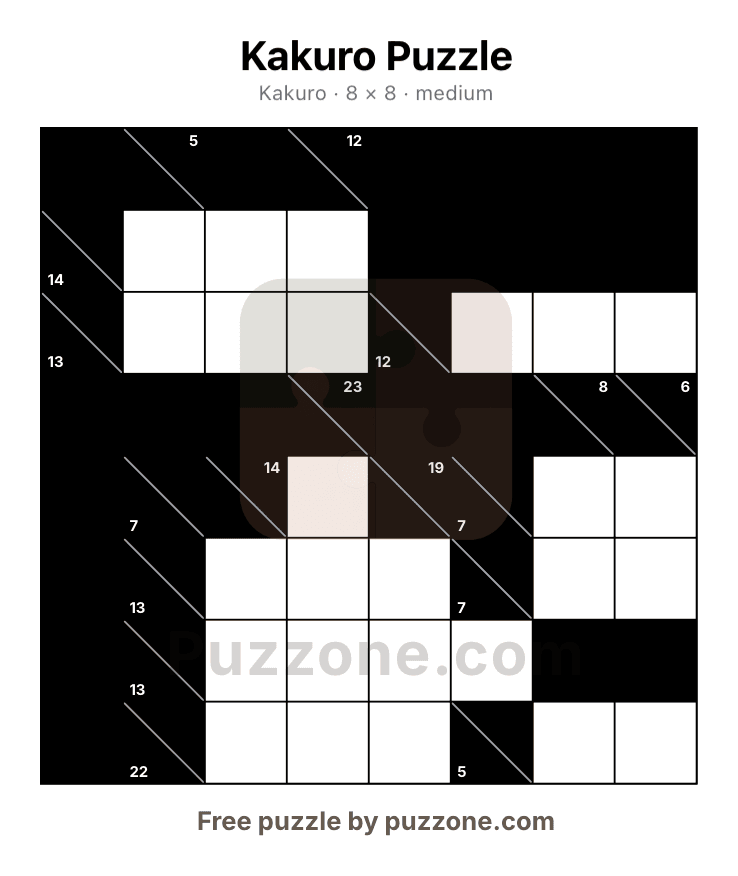
What is kakuro?
Kakuro (also called cross-sums, kakro, or kakoro) is a logic-based number-placement puzzle that combines the grid layout of a crossword with the arithmetic discipline of a math puzzle. You fill the white cells with digits 1-9 so that each horizontal or vertical run of consecutive white cells sums to the clue number shown in the adjacent black cell, without repeating any digit within a single run.
Kakuro was invented in the United States in the 1960s as "Cross Sums" but was rebranded and popularized in Japan in the 1980s by puzzle publisher Maki Kaji — the same editor who popularized sudoku. In Japan, kakuro ranks second only to sudoku in magazine circulation. Solving a kakuro blends sudoku-style deduction with basic addition, which makes it popular with adults who enjoy logic puzzles but want more mental variety than sudoku alone. Try the genre with a free printable kakuro generator.
Kakuro was invented in the United States in the 1960s as "Cross Sums" but was rebranded and popularized in Japan in the 1980s by puzzle publisher Maki Kaji — the same editor who popularized sudoku. In Japan, kakuro ranks second only to sudoku in magazine circulation. Solving a kakuro blends sudoku-style deduction with basic addition, which makes it popular with adults who enjoy logic puzzles but want more mental variety than sudoku alone. Try the genre with a free printable kakuro generator.
Kakuro rules: how to solve kakuro for beginners
Kakuro rules are simple — there are three of them, and every kakuro for beginners strategy derives from them. Here is how to solve kakuro from scratch:
A valid kakuro puzzle has exactly one solution reachable by logic alone. The Puzzone generator verifies uniqueness before publishing, which is why our kakuro puzzles are always solvable without guessing. Kakuro consistently appears on lists of the best number puzzle games for adults — alongside sudoku, kenken, and futoshiki — and has a steeper learning curve than sudoku for the first hour, then a flatter skill cap once magic combinations are memorized.
- Digits 1-9 only. Never zero, never 10+. Each white cell contains exactly one digit.
- Each run must sum to its clue. A "run" is a consecutive sequence of white cells in one row or one column, bounded by black cells or the grid edge. The clue number appears in the adjacent black cell (top-right for across runs, bottom-left for down runs — usually separated by a diagonal slash).
- No repeats within a run. A single run cannot use the same digit twice. But different runs can share digits — the "no repeat" rule applies per run, not across the whole puzzle (unlike sudoku).
A valid kakuro puzzle has exactly one solution reachable by logic alone. The Puzzone generator verifies uniqueness before publishing, which is why our kakuro puzzles are always solvable without guessing. Kakuro consistently appears on lists of the best number puzzle games for adults — alongside sudoku, kenken, and futoshiki — and has a steeper learning curve than sudoku for the first hour, then a flatter skill cap once magic combinations are memorized.
What are kakuro magic combinations?
Magic combinations are the most important concept in kakuro. When a run of a specific length has a specific clue sum, sometimes there is only one possible set of digits that can fill it. These forced placements give you free progress without any deduction work.
Critical magic combinations to memorize:
For a complete magic-combination reference card to keep next to your puzzle, print one from the Puzzone kakuro reference page. Experienced solvers have these memorized for all run lengths from 2 to 9 cells.
Critical magic combinations to memorize:
- Two cells: 3 = {1,2}. 4 = {1,3}. 16 = {7,9}. 17 = {8,9}.
- Three cells: 6 = {1,2,3}. 7 = {1,2,4}. 23 = {6,8,9}. 24 = {7,8,9}.
- Four cells: 10 = {1,2,3,4}. 11 = {1,2,3,5}. 29 = {5,7,8,9}. 30 = {6,7,8,9}.
- Five cells: 15 = {1,2,3,4,5}. 16 = {1,2,3,4,6}. 34 = {4,7,8,9,6}. 35 = {5,6,7,8,9}.
For a complete magic-combination reference card to keep next to your puzzle, print one from the Puzzone kakuro reference page. Experienced solvers have these memorized for all run lengths from 2 to 9 cells.
How do I solve a kakuro puzzle step by step?
The efficient solving order for a kakuro puzzle:
A typical medium kakuro takes 15-25 minutes for an intermediate solver. Expert puzzles can run 45-90 minutes with careful candidate tracking.
- Scan for magic combinations. Walk the grid looking for any run whose (length, sum) pair matches a magic combination. Write the forced digits in lightly as candidates.
- Apply cross-run intersections. Each white cell sits at the intersection of an across run and a down run. If the across run demands {1,2} and the down run demands {2,6,9}, the cell must be 2 (the only shared digit).
- Use elimination from larger runs. A 2-cell run summing to 17 must be {8,9}. This means digits 8 and 9 are used in this run and cannot appear elsewhere in the intersecting runs at those cells.
- Pencil in candidates for harder cells. When direct magic combinations are exhausted, list possible digits in each cell based on the run sum and cell count.
- Apply sudoku-like unique-position logic. If a run needs a 5 and only one of its cells can legally hold a 5 (based on candidates), that cell is 5.
A typical medium kakuro takes 15-25 minutes for an intermediate solver. Expert puzzles can run 45-90 minutes with careful candidate tracking.
How does cross-referencing work in kakuro?
Every white cell in a kakuro grid belongs to exactly two runs — one across and one down. This dual membership is what makes the puzzle solvable; it is the kakuro equivalent of sudoku's row-column-box intersections.
Worked example: consider a cell at the intersection of a 2-cell across run summing to 3 (forced to {1,2}) and a 3-cell down run summing to 23 (forced to {6,8,9}). The cell must contain a digit from both sets. The intersection of {1,2} and {6,8,9} is the empty set — which means the puzzle is invalid or you have made an error elsewhere. In a valid kakuro, every cell has at least one shared digit between its two runs.
Another example: across run {1,2}, down run {2,4,9}. The shared digit is 2, so the cell is forced to 2. The other cell of the across run now must be 1. This cascades — one cross-reference placement often unlocks two or three follow-on forced placements.
Worked example: consider a cell at the intersection of a 2-cell across run summing to 3 (forced to {1,2}) and a 3-cell down run summing to 23 (forced to {6,8,9}). The cell must contain a digit from both sets. The intersection of {1,2} and {6,8,9} is the empty set — which means the puzzle is invalid or you have made an error elsewhere. In a valid kakuro, every cell has at least one shared digit between its two runs.
Another example: across run {1,2}, down run {2,4,9}. The shared digit is 2, so the cell is forced to 2. The other cell of the across run now must be 1. This cascades — one cross-reference placement often unlocks two or three follow-on forced placements.
What's the difference between kakuro and sudoku?
Both puzzles use digits 1-9 with uniqueness constraints, but the structure and cognitive load are different. The table below compares kakuro, sudoku, and futoshiki across the dimensions that matter most for choosing a puzzle format:
For solvers who find sudoku repetitive after months of practice, kakuro offers fresh challenge because every puzzle has a unique grid shape and different magic-combination opportunities. For pure-logic purists, sudoku is slightly "cleaner" because it requires no arithmetic. Many puzzle books include both — see our guide to publishing KDP puzzle books for how mixed-type activity books outsell single-type titles.
Crossword solvers often prefer kakuro over sudoku because the grid layout and across/down clue structure is familiar.
| Dimension | Kakuro | Sudoku | Futoshiki |
|---|---|---|---|
| Digit range | 1-9 | 1-9 | 1-N (where N is grid size) |
| Grid size | 10×10 to 15×15 (irregular) | 9×9 (fixed) | 4×4 to 7×7 (square) |
| Constraints | Run sum + no-repeat in run | Row + column + 3×3 box uniqueness | Row + column uniqueness + inequality signs |
| Arithmetic required | Yes (single-digit addition) | No | No (only comparison) |
| Magic combinations | Essential for fast solving | N/A | N/A |
| Typical solve time (medium) | 15-30 min | 8-15 min | 10-20 min |
| Skill cap | Reached in 4-8 weeks of practice | Reached in months (X-Wing, Swordfish) | Reached in 4-6 weeks |
| Best for | Math-minded solvers | Pure-logic solvers | Algebra-intro students |
For solvers who find sudoku repetitive after months of practice, kakuro offers fresh challenge because every puzzle has a unique grid shape and different magic-combination opportunities. For pure-logic purists, sudoku is slightly "cleaner" because it requires no arithmetic. Many puzzle books include both — see our guide to publishing KDP puzzle books for how mixed-type activity books outsell single-type titles.
Crossword solvers often prefer kakuro over sudoku because the grid layout and across/down clue structure is familiar.
Is kakuro harder than sudoku? (sudoku vs kakuro for new solvers)
The sudoku vs kakuro question comes up constantly for new logic-puzzle players. For most solvers, yes — kakuro is harder at first — kakuro has a steeper learning curve because it requires both memorizing magic combinations and performing mental arithmetic throughout the solve. A beginner in sudoku can succeed with pure pattern scanning; a beginner in kakuro needs at least a basic magic-combination table to make progress.
But the skill cap in kakuro is reached faster. Advanced sudoku techniques (X-Wing, Swordfish, coloring) take months to internalize. Advanced kakuro mostly reduces to rigorous candidate-tracking and applying memorized combinations — both skills that plateau in 4-8 weeks of regular practice.
If you find sudoku too repetitive after extensive play, kakuro will feel genuinely fresh for 3-6 months. If you find sudoku pleasingly meditative, kakuro's arithmetic overhead may feel like homework. It's worth trying 3-5 free kakuro puzzles across different difficulty levels before committing.
But the skill cap in kakuro is reached faster. Advanced sudoku techniques (X-Wing, Swordfish, coloring) take months to internalize. Advanced kakuro mostly reduces to rigorous candidate-tracking and applying memorized combinations — both skills that plateau in 4-8 weeks of regular practice.
If you find sudoku too repetitive after extensive play, kakuro will feel genuinely fresh for 3-6 months. If you find sudoku pleasingly meditative, kakuro's arithmetic overhead may feel like homework. It's worth trying 3-5 free kakuro puzzles across different difficulty levels before committing.
How do I get better at kakuro fast?
Three targeted drills accelerate kakuro skill development:
Within 4-6 weeks of daily solving (15-30 minutes per session), most adults reach "competent" status — able to finish medium puzzles in under 25 minutes. Expert speed (sub-15-minute medium) takes 6+ months.
- Memorize magic combinations. Print a reference card with all unique combinations for run lengths 2-9 across clue values 3-45. Target: recognize any forced combination in under 3 seconds. Most solvers need 2-3 weeks of daily practice to hit this.
- Practice small grids first. Start with 6×6 or 8×8 kakuros before moving to full 15×15. Small grids make it easier to hold the full candidate structure in memory, which speeds up pattern recognition.
- Review your errors. When you get stuck and reveal the solution, identify the missed deduction — was it a magic combination, a cross-reference, or a candidate elimination? Naming the missed technique makes it easier to spot next time.
Within 4-6 weeks of daily solving (15-30 minutes per session), most adults reach "competent" status — able to finish medium puzzles in under 25 minutes. Expert speed (sub-15-minute medium) takes 6+ months.
Where can I get free printable kakuro puzzles?
Printable kakuro is harder to find online than sudoku because the format is more complex to render and fewer free generators produce valid unique-solution puzzles. Puzzone's kakuro generator is one of the few free tools that produces KDP-ready PDFs with verified uniqueness.
Workflow:
For bulk use (classroom packets, puzzle book publishing), generate a batch in the puzzle book creator — you can produce 80-120 kakuro puzzles in a single KDP-ready PDF. All Puzzone kakuros are free for personal and classroom use and have guaranteed unique solutions; publishing them requires Premium.
Workflow:
- Open the kakuro creator.
- Pick a size: small (fast, 10-15 min solve), medium (20-30 min), large (45-60 min).
- Click Generate. A new puzzle with diagonal clue cells appears.
- Download the PDF — puzzle on one page, full answer key on a separate page.
- Print as many copies as you need.
For bulk use (classroom packets, puzzle book publishing), generate a batch in the puzzle book creator — you can produce 80-120 kakuro puzzles in a single KDP-ready PDF. All Puzzone kakuros are free for personal and classroom use and have guaranteed unique solutions; publishing them requires Premium.
Can kakuro be used in math class?
Yes — kakuro is one of the most effective paper puzzles for reinforcing addition facts and number sense in grades 4-8. Unlike drill worksheets, kakuro makes addition feel like detective work: you are using sums to deduce placements, not just computing for its own sake.
Classroom uses:
Teachers can generate a class set with the kakuro maker and print tiered versions for differentiation. Pair with our math puzzle worksheets by grade guide for a full unit of math-integrated puzzles.
Classroom uses:
- Grade 4-5: small (6×6) kakuros with clue sums up to 20. Reinforces single-digit addition and number bonds.
- Grade 6-8: medium (10×10) kakuros with clue sums up to 45. Develops systematic elimination thinking — a bridge skill to algebra.
- Grade 9+: full-size (15×15) kakuros as enrichment or math-club activity. Connects to combinatorics (how many ways can 5 distinct digits from 1-9 sum to X?).
Teachers can generate a class set with the kakuro maker and print tiered versions for differentiation. Pair with our math puzzle worksheets by grade guide for a full unit of math-integrated puzzles.
Kakuro, calcudoku and killer sudoku: how they differ
Three number puzzles are often confused because all three use sums, and the differences matter once you start solving. In kakuro the clue sits outside the run, digits 1 to 9 never repeat inside a run, and the same digit can appear elsewhere in the row — the puzzle is about which combination of distinct digits makes the total. In killer sudoku the underlying grid is a full 9×9 sudoku, cages carry the sums, and the sudoku rules do most of the work while the cages break ties. In calcudoku the grid shrinks to 4×4 through 6×6, cages add subtraction, multiplication and division, and a digit may repeat inside a cage as long as it is in a different row and column. Kakuro rewards combination tables, killer rewards the 45 rule, calcudoku rewards factor thinking.
Frequently asked questions
- Is kakuro a math puzzle or a logic puzzle?
- Both — but the logic dominates. Kakuro uses addition as a constraint, but the solving process is almost entirely deductive (eliminate impossible digits, find forced placements). You never do complex arithmetic; mental addition stays within 9+8+7+6 territory. Purists classify it as a constraint-satisfaction puzzle with arithmetic constraints.
- Do I need to be good at math to play kakuro?
- Only basic single-digit addition. If you can add 7+9 in your head quickly, you have enough arithmetic for any kakuro. The harder skill is memorizing magic combinations (which digit sets sum to each target) and applying systematic elimination — neither is "math" in the academic sense.
- How long does it take to solve a kakuro puzzle?
- Easy small puzzles (6×6 to 8×8): 5-15 minutes. Medium (10×10 to 12×12): 15-30 minutes. Hard large (15×15): 30-90 minutes. Expert solvers clear medium puzzles in under 12 minutes and large puzzles in 20-30 minutes. Speed improves with memorized magic combinations.
- What is the hardest kakuro technique?
- Multi-run candidate chaining — tracking how eliminating a candidate in one run propagates constraints across three or four connected runs. This requires a disciplined pencil-mark system because the human working memory cannot hold the full candidate structure of a 15×15 kakuro. Solvers at this level often use a candidate grid on scratch paper alongside the puzzle.
- Can you guess in kakuro?
- No — well-designed kakuro puzzles are solvable entirely through logic. If you feel like guessing, you are either missing a magic combination or have not fully tracked candidates. Unlike sudoku where guessing-with-backtrack sometimes works on poorly-designed puzzles, kakuro's dense constraint structure usually exposes guesses quickly with a contradiction.
- Where can I find free printable kakuro for seniors or beginners?
- Puzzone's kakuro generator at /create/kakuro produces free printable PDFs with small (easy), medium, and large (hard) options — all with unique solutions and answer keys. Small size is ideal for beginners and seniors because the grid is compact and the magic combinations are fewer. No account and unlimited regeneration.
- Is kakuro the same as calcudoku?
- No. Kakuro uses addition only, with clues outside each run and no repeated digits within a run. Calcudoku uses addition, subtraction, multiplication and division inside outlined cages on a smaller Latin square, and allows a repeated value inside a cage when it falls in a different row and column.
Try it yourself
Create kakuro puzzles for free — no account needed.