
NonogramPublished Mar 6, 2026Updated Sep 27, 202612 min read
How to Solve Nonograms: Picross Guide
Create nonogram— free, no account, PDF + answer key



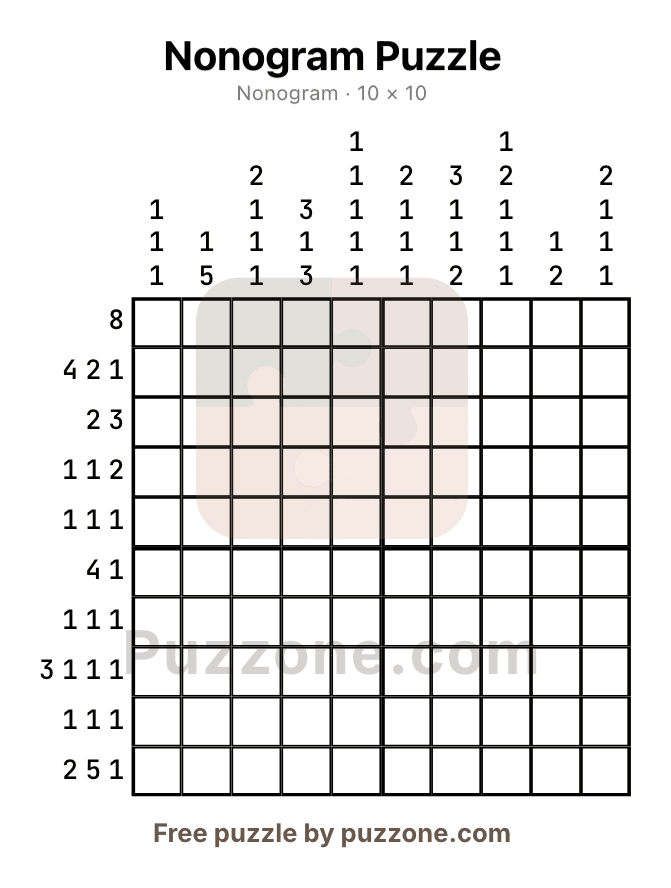
What is a nonogram? (a complete picross guide for nonogram for beginners)
A nonogram — also called a picross guide puzzle, a hanjie puzzle, a griddler, a paint by numbers puzzle, or a Pic-a-Pix — is a grid-based logic puzzle where you fill and cross off cells to reveal a hidden pixel-art picture. Each row and column has a list of numbers indicating the lengths of consecutive filled-cell groups in that line, separated by at least one empty cell.
Nonograms were invented independently in 1987 by two Japanese puzzle designers — Non Ishida and Tetsuya Nishio — and popularized internationally in the 1990s. The Nintendo "Picross" series, launched in 1995, introduced nonograms to millions of players and gave the genre its most common English name. Today, nonograms range from 5×5 introductory puzzles to massive 50×50 "mega-griddlers" that take hours to solve. Try the genre with free printable nonogram puzzles from Puzzone — every download is a printable nonogram PDF with the solution image included on a separate page.
This nonogram tutorial covers all the core nonogram techniques: overlap, edge logic, gap analysis, and griddler solving by row-column cross-reference. By the end you will have the same toolkit a competition solver uses.
Nonograms were invented independently in 1987 by two Japanese puzzle designers — Non Ishida and Tetsuya Nishio — and popularized internationally in the 1990s. The Nintendo "Picross" series, launched in 1995, introduced nonograms to millions of players and gave the genre its most common English name. Today, nonograms range from 5×5 introductory puzzles to massive 50×50 "mega-griddlers" that take hours to solve. Try the genre with free printable nonogram puzzles from Puzzone — every download is a printable nonogram PDF with the solution image included on a separate page.
This nonogram tutorial covers all the core nonogram techniques: overlap, edge logic, gap analysis, and griddler solving by row-column cross-reference. By the end you will have the same toolkit a competition solver uses.
How do you read a nonogram clue?
Each row clue reads left-to-right, each column clue reads top-to-bottom. The numbers list the lengths of consecutive filled-cell groups, in order, with at least one empty cell between adjacent groups.
Examples:
The order matters. "3 1" is different from "1 3" — in "3 1" the three-block comes first, in "1 3" the single cell comes first. Nonogram puzzles are always solvable by pure logic with no guessing required, which means every well-designed nonogram has exactly one solution.
Examples:
- "5" — one group of 5 consecutive filled cells. Everything else in that line is empty.
- "3 1 2" — three groups in order: 3 filled, gap, 1 filled, gap, 2 filled. Minimum line length = 3 + 1 + 1 + 1 + 2 = 8 cells.
- "0" (or blank) — line is completely empty.
- "10" on a 10-wide grid — every cell filled.
The order matters. "3 1" is different from "1 3" — in "3 1" the three-block comes first, in "1 3" the single cell comes first. Nonogram puzzles are always solvable by pure logic with no guessing required, which means every well-designed nonogram has exactly one solution.
How do I solve a nonogram step by step?
The standard solving rhythm for a nonogram:
Good solvers keep filled cells and empty cells visually distinct — filled as solid blocks, empty as dots or small X marks. This prevents confusion when a complex line has mixed states.
- Mark obvious fills. Walk each row and column looking for clues that equal the full line length (completely filled) or zero (completely empty). Mark these first.
- Apply overlap technique. For any single clue larger than half the line length, identify the overlap region that must be filled regardless of where the group starts. These are free wins.
- Process edges. When the first or last cell of a line is filled, extend outward to mark the minimum span of the first/last group.
- Use cross-reference between rows and columns. Filled cells from rows inform columns and vice versa. Each mark you make updates the constraints on the intersecting line.
- Mark confirmed empty cells with X or dot. Empty marks are as valuable as filled marks — they narrow where groups can go.
- Iterate. Keep cycling through the grid. Each pass uncovers new forced cells as constraints tighten.
Good solvers keep filled cells and empty cells visually distinct — filled as solid blocks, empty as dots or small X marks. This prevents confusion when a complex line has mixed states.
What is the overlap technique?
The overlap technique is the most productive single method for beginning solvers. The idea: if a group is large enough that it cannot fit in a line without some cells being filled regardless of starting position, those cells are forced.
Example: a 10-cell row with clue "7". The block could start as far left as position 1 (filling cells 1-7) or as far right as position 4 (filling cells 4-10). In every valid position, cells 4-7 are filled — that's the overlap. Mark them immediately.
The formula: for a single clue N in a line of length L, the overlap region is from position L−N+1 to position N. Overlap exists whenever N > L/2.
For multi-group clues like "3 2 1" in a 10-cell row, compute the minimum total length (3 + 1 + 2 + 1 + 1 = 8) and find the slack (10 − 8 = 2). Any group longer than the slack has forced cells. The "3" group has slack 2 so cells at positions 3 from its earliest and latest starts overlap. Overlap analysis can be slow on large puzzles but it's the backbone technique — master it before moving to other methods.
Example: a 10-cell row with clue "7". The block could start as far left as position 1 (filling cells 1-7) or as far right as position 4 (filling cells 4-10). In every valid position, cells 4-7 are filled — that's the overlap. Mark them immediately.
The formula: for a single clue N in a line of length L, the overlap region is from position L−N+1 to position N. Overlap exists whenever N > L/2.
For multi-group clues like "3 2 1" in a 10-cell row, compute the minimum total length (3 + 1 + 2 + 1 + 1 = 8) and find the slack (10 − 8 = 2). Any group longer than the slack has forced cells. The "3" group has slack 2 so cells at positions 3 from its earliest and latest starts overlap. Overlap analysis can be slow on large puzzles but it's the backbone technique — master it before moving to other methods.
What is edge logic in nonogram solving?
Edge logic is how you use known states at the boundaries of a line to constrain group placement. Four edge patterns produce immediate progress:
Edge logic compounds with the overlap technique — work both together on every line for maximum progress per pass.
- Filled cell at the edge. If cell 1 is filled and the first clue is "4", cells 1-4 are all filled. Then cell 5 must be empty (group separator). The pattern works symmetrically from the right edge.
- Empty cell at the edge. If cell 1 is empty, the first group cannot start at position 1. This shifts all overlap calculations by one or more cells.
- Filled cell one away from edge. If cell 2 is filled and cell 1 is not yet determined, cell 1 may or may not be part of the first group. But you can deduce that the group has at least 1 filled cell reaching toward the edge.
- Group must touch edge. If the first clue is the only way to account for filled cells in the leftmost region, that group is forced to sit at the edge.
Edge logic compounds with the overlap technique — work both together on every line for maximum progress per pass.
How do I handle multi-group clues?
Multi-group clues like "3 2 1 4" require thinking about total required space: sum of groups + (number of gaps × minimum gap size). For "3 2 1 4" in any line: 3+2+1+4 = 10 cells filled, plus 3 required gaps = 13 total cells minimum.
If the line is exactly 13 cells, the entire line is forced — no slack. If the line is 15 cells, slack = 2, so each group can shift left or right by up to 2 positions. Groups with length greater than the slack have forced (overlap) cells.
Process tips for multi-group clues:
Multi-group clues are where nonogram logic feels most rewarding — one placement cascades into three or four follow-on deductions.
If the line is exactly 13 cells, the entire line is forced — no slack. If the line is 15 cells, slack = 2, so each group can shift left or right by up to 2 positions. Groups with length greater than the slack have forced (overlap) cells.
Process tips for multi-group clues:
- Process the leftmost and rightmost groups first — they have the most constraint from the edges.
- Look for separating empty cells. If a cell between two potential groups is confirmed empty, the groups split into two independent sub-problems.
- After placing any group, mark cells immediately before and after it as empty (every group is separated by at least one empty cell).
Multi-group clues are where nonogram logic feels most rewarding — one placement cascades into three or four follow-on deductions.
What's the difference between easy and hard nonograms?
Difficulty in nonograms is driven primarily by grid size and clue density:
A secondary difficulty factor: clarity of the hidden picture. Abstract patterns (random shapes) are usually harder than recognizable images (animals, objects) because solvers can partially visualize the final image and confirm placements intuitively. Puzzone's nonogram generator offers both abstract and themed pictures across difficulty levels.
- Easy (5×5 to 10×10). Short lines where overlap and edge logic solve most cells directly. Solve time: 5-15 minutes.
- Medium (10×10 to 15×15). More multi-group clues, less immediate overlap. Solve time: 15-45 minutes.
- Hard (15×15 to 20×20). Dense clues requiring cross-reference between rows and columns. Solve time: 45-120 minutes.
- Expert (20×20 to 30×30+). Sparse filled regions, many deductions required per placement. Can take 2-5 hours.
A secondary difficulty factor: clarity of the hidden picture. Abstract patterns (random shapes) are usually harder than recognizable images (animals, objects) because solvers can partially visualize the final image and confirm placements intuitively. Puzzone's nonogram generator offers both abstract and themed pictures across difficulty levels.
What are common beginner mistakes in nonograms?
Five traps that slow down beginner solvers:
Fixing these five habits cuts typical solve time by 30-50% within a week of disciplined practice.
- Not marking empty cells. Many beginners only mark filled cells, but confirmed empty cells carry equal information. Always mark cells you know are empty with a dot or X.
- Forgetting the gap rule. Adjacent groups must be separated by at least one empty cell. After completing a group, immediately mark the surrounding cells.
- Rushing past line clues. A quick scan can miss forced cells. Slow down and apply overlap+edge logic systematically to each line before moving on.
- Guessing on hard puzzles. A valid nonogram is always solvable by logic. Guessing and backtracking is slower than applying the right technique.
- Not alternating rows and columns. Beginners often solve all rows, then all columns, then all rows again. Better: work both simultaneously, letting each filled cell inform the intersecting line.
Fixing these five habits cuts typical solve time by 30-50% within a week of disciplined practice.
Are nonograms good for your brain? (nonogram vs sudoku for cognitive training)
Nonograms exercise three cognitive systems heavily: spatial reasoning (mentally tracking the evolving grid), working memory (holding multi-step deductions), and logical inference (chaining constraints across rows and columns). A common comparison is nonogram vs sudoku — both are constraint-satisfaction logic puzzles, but nonograms add a spatial-pattern layer (the hidden picture) that sudoku does not have.
A 2020 study in Frontiers in Psychology examined puzzle-solving's effect on working memory in adults aged 40-65 and found that complex logic puzzles (including nonograms and sudoku) produced measurable improvement on dual-task memory assessments after 8 weeks of daily 20-minute sessions. The effect is most pronounced for puzzle types that require simultaneous constraint tracking — which nonograms do more intensively than sudoku.
For kids, nonograms teach systematic thinking and patience. The ability to say "I know this cell is empty because of constraints I worked out 10 minutes ago" builds the same cognitive muscle used in mathematical proofs. Many STEM-focused schools include nonograms in logic-enrichment curricula.
A 2020 study in Frontiers in Psychology examined puzzle-solving's effect on working memory in adults aged 40-65 and found that complex logic puzzles (including nonograms and sudoku) produced measurable improvement on dual-task memory assessments after 8 weeks of daily 20-minute sessions. The effect is most pronounced for puzzle types that require simultaneous constraint tracking — which nonograms do more intensively than sudoku.
For kids, nonograms teach systematic thinking and patience. The ability to say "I know this cell is empty because of constraints I worked out 10 minutes ago" builds the same cognitive muscle used in mathematical proofs. Many STEM-focused schools include nonograms in logic-enrichment curricula.
Where can I get free printable nonograms?
Printable nonograms are less common online than sudoku because the format requires careful grid-and-clue rendering. Puzzone's free nonogram generator produces printable PDFs with clear row and column clues and a guaranteed unique-solution picture reveal.
Workflow:
For regular practice, generate a nonogram puzzle book with 30-50 puzzles across three difficulty levels. Publishing them commercially, including as a KDP puzzle book, requires Premium. See our KDP puzzle book publishing guide for the full workflow.
Workflow:
- Open the nonogram creator.
- Choose grid size: small (5×5 to 10×10, good for beginners), medium (10×10 to 15×15), or large (15×15 to 20×20).
- Click Generate. A fresh puzzle with preset image appears.
- Download the PDF — puzzle on one page, full solution (with the revealed picture) on a separate page.
- Print and solve.
For regular practice, generate a nonogram puzzle book with 30-50 puzzles across three difficulty levels. Publishing them commercially, including as a KDP puzzle book, requires Premium. See our KDP puzzle book publishing guide for the full workflow.
Other picture and region logic puzzles worth solving
Nonograms give you run lengths along each row and column. Three related puzzles use different clue types over the same kind of grid, and each one exercises a different habit. Mosaic, published as fill-a-pix, puts a number in a cell that counts the shaded cells in its own 3×3 neighbourhood; where a nonogram rewards reading long lines, a mosaic rewards local deduction and spreads outwards from the 0s and 9s. Shikaku asks you to cut the grid into rectangles, each containing one number equal to its area, so the reasoning is about factor pairs and space rather than sequences. Star battle places stars so every row, column and region holds the same number with none touching. All three print free with answer keys, in the same black-and-white format as a nonogram.
Frequently asked questions
- What is the difference between nonograms, Picross, and Hanjie?
- They are the same puzzle type with different regional names. "Nonogram" is the generic English term (derived from inventor Non Ishida). "Picross" is the Nintendo brand name popularized by the Game Boy series. "Hanjie" is the Japanese term, and "Griddlers" and "Paint by Numbers" are also common English names. All four describe identical puzzles — fill cells based on row and column clues to reveal a hidden picture.
- Are nonograms hard to learn?
- Easier than sudoku for visual thinkers, harder for math-focused solvers. The clue notation takes 10-15 minutes to internalize. The core techniques (overlap and edge logic) can be learned in one 20-minute tutorial session. Most beginners can complete their first 10×10 nonogram within 30 minutes of reading the rules, though proficiency on larger grids takes several weeks of practice.
- How long should a nonogram take to solve?
- Easy 5×5 to 10×10 puzzles: 5-15 minutes. Medium 10×10 to 15×15: 15-45 minutes. Hard 15×15 to 20×20: 45-120 minutes. Expert 20×20+ mega-griddlers can take 2-5 hours or more. Solvers typically enjoy the longer sessions because the emerging picture keeps engagement high through the late-solve phase.
- Do I need to guess to solve a nonogram?
- No — any valid nonogram is solvable entirely through logic. If a puzzle you are working on seems to require guessing, either you are missing a technique (usually overlap on a multi-group clue) or the puzzle was poorly designed with multiple solutions. Good generators (including Puzzone's) verify uniqueness before publishing.
- What is the best starting technique for a beginner?
- The overlap technique on single-clue rows and columns. Find every line where the clue is more than half the line length. Mark the overlap cells as filled. This alone solves 20-30% of most beginner puzzles and unlocks cross-reference constraints that make the rest tractable.
- Can nonograms be used in math or logic classrooms?
- Yes. Nonograms are excellent for teaching systematic constraint satisfaction in grades 5-12. They connect to topics in discrete math (combinatorics), logic proof writing (deductive reasoning from premises), and early computer science (constraint propagation algorithms used in SAT solvers). Generate classroom-ready nonograms at /create/nonogram and print a tiered set for differentiation.
- What is the difference between a nonogram and a mosaic puzzle?
- A nonogram gives run lengths for each row and column, so you solve by reading whole lines. A mosaic, or fill-a-pix, puts counts inside individual cells describing their own 3×3 neighbourhood, so you solve locally and spread outwards. Both produce a picture when finished.
Try it yourself
Create nonogram puzzles for free — no account needed.