
MatchingPublished Mar 6, 2026Updated Sep 27, 202612 min read
Matching Worksheets for Kids by Subject
Create matching— free, no account, PDF + answer key



What is a matching worksheet?
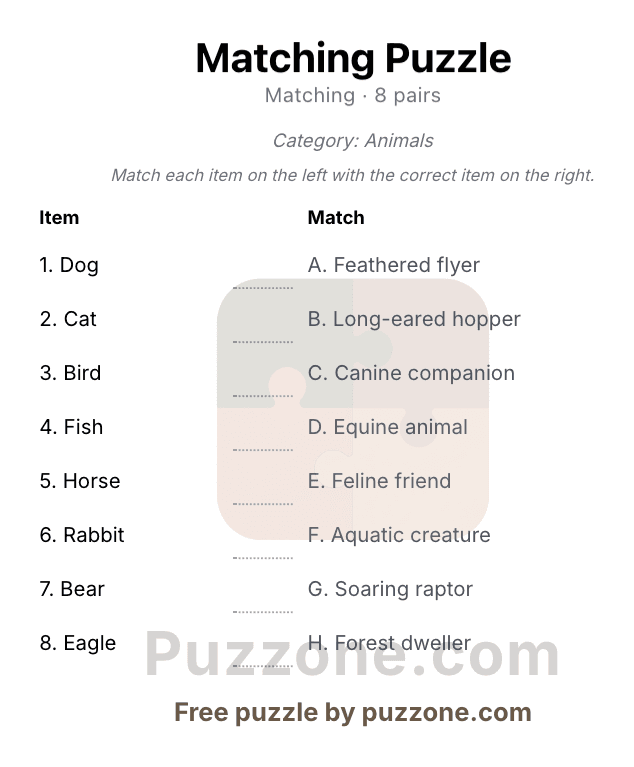
A matching worksheet is a two-column activity where students connect items in one column to their pairs in another column — typically by drawing lines between them or writing matching letters. Classic examples: terms → definitions, animals → habitats, countries → capitals, fractions → decimals, authors → books.
Matching worksheets are one of the most under-appreciated teaching tools in K-8 education. They're fast to complete (5-10 minutes), easy to grade (visual scan works), require no advanced literacy (younger kids can match pictures to words), and directly test the associative knowledge that most curricula actually care about. For teachers, the format scales from kindergarten ("match upper-case to lower-case letters") through high school ("match Supreme Court cases to their rulings") without changing its underlying structure. Generate yours for free at Puzzone's matching worksheet maker.
Matching worksheets are one of the most under-appreciated teaching tools in K-8 education. They're fast to complete (5-10 minutes), easy to grade (visual scan works), require no advanced literacy (younger kids can match pictures to words), and directly test the associative knowledge that most curricula actually care about. For teachers, the format scales from kindergarten ("match upper-case to lower-case letters") through high school ("match Supreme Court cases to their rulings") without changing its underlying structure. Generate yours for free at Puzzone's matching worksheet maker.
Why does a matching worksheet for kids work so well?
A matching activity for grades K-12 hits three cognitive mechanisms simultaneously, which is why a matching worksheet for kids consistently outperforms traditional fill-in-the-blank or multiple-choice for vocabulary review:
For young children (K-2), matching also develops early reading skills through pattern recognition between printed words and images. It's often the first "written test" format kids can succeed at, building confidence before harder assessments. The same format works as a vocabulary matching game in grades 3-8 and as foundational reading comprehension worksheets in early grades. Special education puzzle worksheets often lead with matching tasks because the visual structure reduces cognitive load — recall is easier when the answer is in front of you, just unlinked.
- Retrieval practice. Students must pull the association from memory (e.g., "which habitat does a dolphin live in?"). Retrieval practice is the most evidence-backed study technique in cognitive psychology — multiple studies show measurable retention gains over passive re-reading (Roediger & Karpicke, 2006).
- Dual encoding. Seeing both columns simultaneously forces students to process the items in relation to each other, not in isolation. This builds relational understanding rather than rote memorization.
- Low-anxiety assessment. The answers are visible (just unlabeled), which reduces the recall-from-blank-memory pressure of traditional quizzes. Students who freeze on fill-in-the-blank often do fine on matching.
For young children (K-2), matching also develops early reading skills through pattern recognition between printed words and images. It's often the first "written test" format kids can succeed at, building confidence before harder assessments. The same format works as a vocabulary matching game in grades 3-8 and as foundational reading comprehension worksheets in early grades. Special education puzzle worksheets often lead with matching tasks because the visual structure reduces cognitive load — recall is easier when the answer is in front of you, just unlinked.
What matching ideas work for science class? (a science matching activity for every grade)
A science matching activity is the highest-impact subject application for matching worksheets because so much of science vocabulary is associative — terms paired with definitions, species with habitats, elements with properties. Top matching ideas by grade:
Generate any of these at the matching worksheet maker — paste your term-pair list and download a PDF in 30 seconds.
- Grades K-2: Animals → Habitats (bear:forest, dolphin:ocean, penguin:antarctica). Animals → Babies (cow:calf, sheep:lamb). Animal → Sound (cow:moo, duck:quack).
- Grades 3-5: Body parts → Functions (heart:pumps blood, lungs:breathing, brain:thinking). Planets → Characteristics (Jupiter:largest, Mercury:closest to sun, Mars:red). States of matter → Examples (solid:ice, liquid:water, gas:steam).
- Grades 6-8: Elements → Symbols (oxygen:O, gold:Au, sodium:Na). Cells → Functions (mitochondria:powerhouse, nucleus:DNA control). Biomes → Climates (tundra:cold and dry, rainforest:warm and wet).
- Grades 9-12: Compounds → Formulas (water:H2O, carbon dioxide:CO2, table salt:NaCl). Laws → Scientists (gravity:Newton, relativity:Einstein). Organelles → Functions at cellular level.
Generate any of these at the matching worksheet maker — paste your term-pair list and download a PDF in 30 seconds.
What matching ideas work for math class?
Math matching worksheets are particularly effective because math vocabulary and representation change frequently in K-8 (fraction forms, geometric shape names, operation symbols). Matching activities help students connect representations across formats.
For a full math-puzzle curriculum, pair matching worksheets with our upcoming math puzzle worksheets by grade guide.
- Grades K-1: Numbers → Quantities (3:•••, 5:•••••). Shapes → Names (circle, square, triangle). Time → Clock faces.
- Grades 2-3: Fractions → Pictures (1/4:shaded quarter circle). Money amounts → Coin combinations. Addition problems → Answers.
- Grades 4-5: Fractions → Decimals (1/4:0.25, 1/2:0.5, 3/4:0.75). Fractions → Percentages (1/4:25%). Geometry shapes → Properties (triangle:3 sides, hexagon:6 sides).
- Grades 6-8: Equations → Solutions (2x+4=10 : x=3). Word problems → Equations. Units → Measurement contexts (kilometer:distance, liter:volume).
- Grades 9-12: Theorems → Formulas (Pythagoras:a²+b²=c²). Functions → Graphs. Derivatives → Original functions.
For a full math-puzzle curriculum, pair matching worksheets with our upcoming math puzzle worksheets by grade guide.
What matching ideas work for reading and language arts?
Reading and language arts is the broadest matching-worksheet territory because almost every language concept involves associations.
Special use: ESL matching worksheets bridging L1 meaning to L2 spelling. A beginner English learner matches Spanish vocabulary to English equivalents; an intermediate learner matches English phrasal verbs to definitions. This is one of the most effective ESL-specific activities. Generate at the ESL puzzle maker.
- K-2: Upper-case letters → Lower-case letters (A:a, B:b). Rhyming words (cat:bat, dog:log). Pictures → Words (🐶:dog, ☀️:sun).
- Grades 3-5: Vocabulary → Definitions. Synonyms → Words (happy:joyful, fast:quick). Antonyms → Words (hot:cold, big:small). Authors → Book titles (Dr. Seuss:The Cat in the Hat).
- Grades 6-8: Parts of speech → Examples (noun:table, verb:run, adjective:red). Prefixes/suffixes → Meanings (un-:not, -ness:state of). Literary devices → Definitions (metaphor:comparison without like/as).
- Grades 9-12: Literary works → Authors. Characters → Novels. Rhetorical devices → Functions. Grammar rules → Examples.
Special use: ESL matching worksheets bridging L1 meaning to L2 spelling. A beginner English learner matches Spanish vocabulary to English equivalents; an intermediate learner matches English phrasal verbs to definitions. This is one of the most effective ESL-specific activities. Generate at the ESL puzzle maker.
How do I use matching worksheets as formative assessment?
Matching worksheets are the fastest formative-assessment tool in a K-8 teacher's kit. A typical 10-item matching worksheet takes students 5-8 minutes and takes the teacher 3-4 minutes to visually scan the classroom for progress.
Best practices for using matching as formative assessment:
Avoid grading matching worksheets for points — they're a learning and assessment tool, not a grading instrument. Peer-check in pairs (students swap and check against the answer key on a projector) takes 2 minutes and builds self-correction habits.
Best practices for using matching as formative assessment:
- Beginning of class (activation): hand out a matching worksheet on yesterday's content. 5 minutes to complete, quick walk of the room, you know who needs reteaching before starting today's lesson.
- End of class (exit ticket): hand out a matching worksheet on today's key concepts. Collect as students leave. 5 minutes to sort while tidying up — you know if the lesson stuck.
- Pre-quiz warm-up: matching worksheet the day before a quiz to surface which students need additional support.
- Unit review: 15-20 item comprehensive matching worksheet covering all unit vocabulary.
Avoid grading matching worksheets for points — they're a learning and assessment tool, not a grading instrument. Peer-check in pairs (students swap and check against the answer key on a projector) takes 2 minutes and builds self-correction habits.
How do I make matching worksheets accessible for different levels?
Differentiation in matching worksheets is controlled by two parameters: number of pairs and similarity of distractors.
Secondary differentiation: visual vs. text-only formats. K-2 students benefit from picture-word matching; older students handle word-word and definition-term formats. The matching worksheet generator lets you generate three versions of the same content by toggling pair count and adding distractor items — 5 minutes of prep produces three differentiated worksheets.
For students with dyslexia or processing differences, use larger fonts (16-18pt), clear sans-serif typefaces, and well-spaced pairs. Matching is an especially dyslexia-friendly format because it doesn't require isolated recall of spellings.
- Support level: 5-8 pairs, obviously different items (bear→forest vs. dolphin→ocean — unrelated pairs).
- On-level: 10-12 pairs, some pairs share surface features (all animals or all sea creatures so kids must process deeper associations).
- Challenge level: 12-18 pairs with "red herring" items that sound plausible but don't match (add 2-3 extra items in the right column that don't pair with anything).
Secondary differentiation: visual vs. text-only formats. K-2 students benefit from picture-word matching; older students handle word-word and definition-term formats. The matching worksheet generator lets you generate three versions of the same content by toggling pair count and adding distractor items — 5 minutes of prep produces three differentiated worksheets.
For students with dyslexia or processing differences, use larger fonts (16-18pt), clear sans-serif typefaces, and well-spaced pairs. Matching is an especially dyslexia-friendly format because it doesn't require isolated recall of spellings.
What's the difference between matching worksheets and multiple-choice?
Both matching and multiple-choice are recognition-based assessment formats — students don't produce answers from scratch, they identify correct answers from options. But the cognitive demands differ:
Matching is a stronger assessment for relational knowledge (pairings, associations, classifications) and weaker for deep-understanding questions where explanation matters. Multiple-choice is stronger for testing specific facts, especially with well-crafted distractors.
For a K-8 teacher, matching worksheets outperform multiple-choice on most common learning objectives: vocabulary, classification, term-to-definition, cause-to-effect. Multiple-choice wins for deeper comprehension questions. Use both strategically.
- Multiple-choice presents one item with 4 distractor options. Guessing probability: 25%. Focused on single-concept recognition.
- Matching worksheets present 10-15 items with 10-15 options across both columns. Each pair reduces the options for remaining pairs. Guessing probability for a 10-item worksheet: effectively 1 in 10 for the first pair, then even lower as pairs are eliminated.
Matching is a stronger assessment for relational knowledge (pairings, associations, classifications) and weaker for deep-understanding questions where explanation matters. Multiple-choice is stronger for testing specific facts, especially with well-crafted distractors.
For a K-8 teacher, matching worksheets outperform multiple-choice on most common learning objectives: vocabulary, classification, term-to-definition, cause-to-effect. Multiple-choice wins for deeper comprehension questions. Use both strategically.
How do I create effective matching worksheets without wasting time?
The fastest workflow using Puzzone's matching worksheet maker:
Total time for a new matching worksheet: 2-3 minutes (mostly typing the pairs). For a 30-pair library covering a unit, budget 15-20 minutes of one-time setup. Once your pair library is built, generating daily exit-ticket matching worksheets takes 30 seconds — regenerate for a different shuffle order on the same pair set.
- Open the matching creator.
- Type or paste your pairs in "term: match" format — one pair per line (e.g., "bear: forest" / "dolphin: ocean" / "penguin: antarctica").
- Pick layout: standard (10-12 pairs), compact (6-8 pairs, more white space), or extended (15-20 pairs).
- Click Generate. The right column is automatically shuffled so matches aren't in obvious order.
- Download the PDF — numbered items on the left, lettered matches on the right, answer key on a separate page.
- Print a class set.
Total time for a new matching worksheet: 2-3 minutes (mostly typing the pairs). For a 30-pair library covering a unit, budget 15-20 minutes of one-time setup. Once your pair library is built, generating daily exit-ticket matching worksheets takes 30 seconds — regenerate for a different shuffle order on the same pair set.
Where can I get free printable matching worksheets?
Puzzone's matching worksheet maker is free to use without an account, and produces clean printable PDFs with answer keys. Teachers selling supplementary worksheets or publishers building activity books need Premium, which adds commercial rights.
For subject-specific matching worksheets, Puzzone also has dedicated generators pre-loaded with content:
For publishers: bundle matching worksheets with word searches, crosswords, and word scrambles into a KDP-ready PDF using the puzzle book creator. Activity books with mixed puzzle formats outsell single-type books because they appeal to a broader buyer demographic. See our KDP puzzle book publishing guide for the full workflow.
For subject-specific matching worksheets, Puzzone also has dedicated generators pre-loaded with content:
- General matching worksheet maker — any subject, any topic.
- ESL puzzle maker — includes bilingual matching templates for L1-to-L2 vocabulary.
- Vocabulary worksheet generator — word-to-definition matching with suggested vocabulary banks.
For publishers: bundle matching worksheets with word searches, crosswords, and word scrambles into a KDP-ready PDF using the puzzle book creator. Activity books with mixed puzzle formats outsell single-type books because they appeal to a broader buyer demographic. See our KDP puzzle book publishing guide for the full workflow.
When matching is the wrong format
A matching worksheet is the fastest formative check there is: two columns, one pass, instantly markable. It stops being the right choice in two cases. If the content is a sequence or a procedure, matching flattens it — pairing step names to descriptions tests recognition, not order. If a child is still building English vocabulary, a matching sheet tests the language rather than the content. Both cases have printable alternatives. For sequencing, an A-to-Z puzzle or a word ladder makes order the point of the exercise. For a language-free logic activity, binary puzzles and number searches need no reading at all, which makes them useful for newly arrived pupils who should still get a real task rather than a colouring sheet.
Frequently asked questions
- What age is best for matching worksheets?
- Matching worksheets work for every age from preschool (picture-to-word matching) through high school (literary works to authors, chemical formulas to compounds). The format scales by changing content complexity and pair count — 5-6 simple pairs for preschoolers, 15-20 content-heavy pairs for high schoolers. It's one of the most age-flexible worksheet formats available.
- How many pairs should a matching worksheet have?
- 5-8 pairs for K-2, 10-12 pairs for grades 3-5, 12-15 pairs for grades 6-8, 15-20 pairs for high school. Below 5 pairs, the activity is too short to produce measurable engagement. Above 20 pairs, students fatigue and accuracy drops. Mixed-difficulty matching with 2-3 bonus pairs (marked as "challenge") works well for heterogeneous classrooms.
- Should I use pictures or text in matching worksheets?
- Pictures for K-2 students and for pre-literate or ESL learners. Text-only for grades 3+ once reading fluency is established. Mixed formats (picture on one column, word on the other) work well for early readers and for vocabulary-building ESL exercises. Teacher-generated matching worksheets on Puzzone use text by default; add custom images if needed for specific grade levels.
- Can I grade matching worksheets for points?
- Best practice is to use matching worksheets for formative assessment rather than summative grades. They're too recognition-oriented (not recall-oriented) to be a fair summative measure, and their speed makes them more useful as ongoing checks than as graded instruments. Use them to inform reteaching decisions, not to determine final grades.
- Are matching worksheets good for ESL students?
- Yes — matching worksheets are one of the most effective ESL activities because they allow students to bridge L1 meaning to L2 spelling without requiring L2 production. Matching Spanish words to English equivalents, or English words to definition explanations, builds vocabulary recognition without the spelling burden that scrambles and fill-in-the-blank impose.
- Where can I generate free matching worksheets?
- Puzzone's matching worksheet maker at /create/matching generates free printable PDF matching worksheets with answer keys. Enter your term-pair list in "term: match" format and download a PDF in under 30 seconds. No account required; selling the worksheets or publishing them requires Premium.
- When should I not use a matching worksheet?
- When the content is a sequence or procedure, because matching tests recognition rather than order, and when the pupil is still building English vocabulary, because the sheet then tests language instead of content. Sequencing puzzles and language-free logic puzzles cover those two cases.
Try it yourself
Create matching puzzles for free — no account needed.