
CrosswordPublished Mar 6, 2026Updated Sep 27, 202612 min read
How to Make a Crossword Puzzle: Step-by-Step
Create crossword— free, no account, PDF + answer key



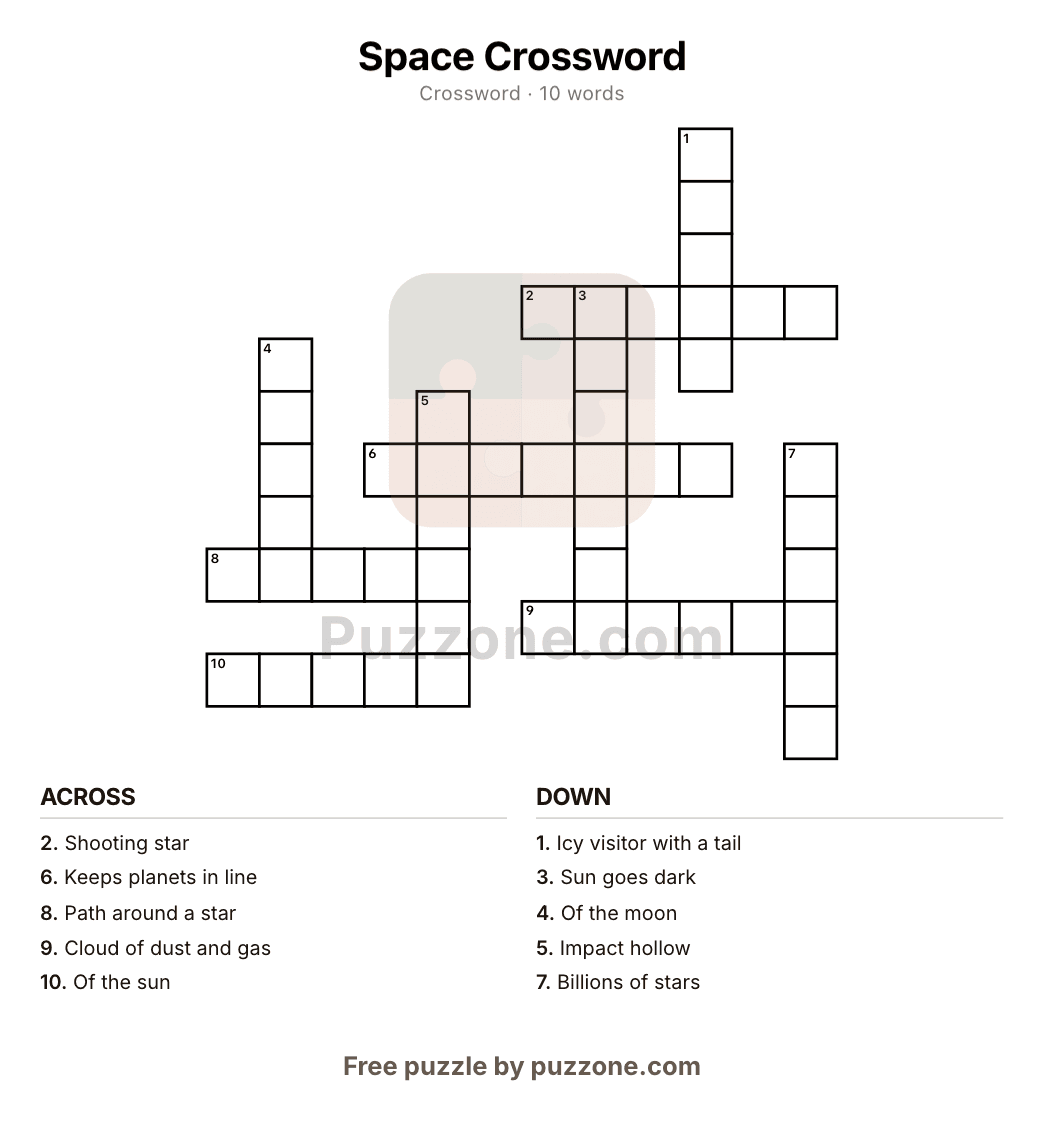
How to make a crossword puzzle, in one paragraph
Making your own crossword puzzle is straightforward: pick 15–25 words related to a theme, write short unambiguous clues for each, paste them into a free crossword puzzle maker with answer key, and export the generated printable crossword puzzle as a print-ready PDF or a shareable online link. The whole process takes about five minutes with the right tool and roughly an hour by hand on graph paper. This guide walks through every step — word selection, clue writing, grid generation, review, and export — and covers crossword variations (American, British, kid-friendly), common mistakes, and specific tips for teachers (including a vocabulary crossword puzzle maker for teachers workflow), event planners building a wedding crossword puzzle, seniors needing large print crossword puzzles for seniors, ESL students, and Amazon KDP publishers selling printable crossword puzzles for adults.
If you want to skip straight to the tool, Puzzone is a free crossword puzzle maker no sign up required — paste a word list, click Generate, and download a PDF.
If you want to skip straight to the tool, Puzzone is a free crossword puzzle maker no sign up required — paste a word list, click Generate, and download a PDF.
What is a crossword puzzle?
A crossword puzzle is a word game played on a rectangular grid of black and white squares, where solvers fill in words horizontally ("across") and vertically ("down") based on numbered clues. Each white square holds one letter; adjacent entries share letters at their intersections, so a solved grid reads as words both ways. The format was invented by journalist Arthur Wynne in 1913 for the New York World newspaper and has become a daily staple in newspapers, magazines, classrooms, and puzzle books worldwide. Modern crosswords typically contain 20–80 words and use 180-degree rotational symmetry for visual balance.
Who makes custom crosswords?
Custom crossword makers come from every corner of the internet. Teachers build vocabulary crossword puzzles as homework, quizzes, or sub-plans — science terms, history dates, Spanish verbs, spelling words. Event planners use themed crosswords as icebreakers at weddings, bridal showers, and corporate retreats. Self-publishers produce large-print crossword collections for seniors and sell them on Amazon KDP. Homeschool parents plug custom crosswords into weekly lesson plans. Marketers use branded puzzles in newsletters and trade-show handouts. If you have a specific word list and a purpose, a custom crossword beats anything generic you could buy off the shelf.
Step 1: Gather your theme and word list
Start with 15–25 words tied to a single clear theme. Fewer than 10 and your grid looks sparse; more than 30 and the generator struggles to fit them all cleanly.
Word-selection rules that actually matter:
Example for a 7th-grade biology worksheet: MITOCHONDRIA, RIBOSOME, DNA, PROTEIN, NUCLEUS, CELL, ENZYME, GLUCOSE, LIPID, OXYGEN, CHLOROPLAST, MEMBRANE, CYTOPLASM, ORGANELLE.
Word-selection rules that actually matter:
- Mix lengths. Long words (8+ letters) anchor the grid; short words (3–5 letters) fill gaps. Aim roughly 25% long, 50% medium (5–7 letters), 25% short.
- Favor letter diversity. Words with common letters (E, A, R, T, O, N, S) intersect more easily than words heavy on J, Q, X, Z.
- Single words only. Most generators can't handle phrases, hyphens, or spaces — "ice cream" becomes "ICECREAM" (remove the space) or split it into two entries.
- Match your audience. Words your solvers have already seen. Don't put ZYZZYVA in a second-grade vocabulary puzzle unless you want it empty.
Example for a 7th-grade biology worksheet: MITOCHONDRIA, RIBOSOME, DNA, PROTEIN, NUCLEUS, CELL, ENZYME, GLUCOSE, LIPID, OXYGEN, CHLOROPLAST, MEMBRANE, CYTOPLASM, ORGANELLE.
Step 2: Write clear, unambiguous clues
A crossword is only as good as its clues. Each word needs one clue (labeled "across" or "down"). Strong clues are:
Clue styles with examples:
- Concise — 3–10 words. "A cell's power plant" beats "The organelle responsible for ATP production through cellular respiration."
- Unambiguous — exactly one answer should fit. Avoid "type of fish" if your word is SALMON. Prefer "pink fish often served smoked" or "popular sushi choice."
- Consistent in difficulty — mix easy (direct definitions), medium (fill-in-the-blank, partial quotes), and hard (wordplay, double meanings) calibrated to your audience.
- Grade-appropriate — for ESL learners, pull definitions straight from their vocabulary list. For adults, lean into cryptic or trivia-style references.
Clue styles with examples:
- Direct definition: "Capital of France" → PARIS
- Fill-in-the-blank: "___ of the valley" → LILY
- Category: "Jupiter or Saturn" → PLANET
- Wordplay: "Headwear seen at weddings" → VEIL
- Trivia: "1969 moon lander" → EAGLE
Step 3: Generate the crossword grid
This is the hard part by hand and the easy part with a crossword generator. The algorithm has to test hundreds of possible arrangements to find the grid that maximizes intersections, uses the smallest bounding box that fits all words, distributes words evenly, and (ideally) produces rotational symmetry.
At Puzzone's crossword puzzle maker, paste your word-clue pairs into the input box and click Generate. The generator runs 100+ arrangements in under a second and shows you the top layout. Regenerate if the first pass feels sparse, or accept it and move on. The tool is free and needs no sign-up. Grid generation runs in your browser, so your word list stays on your device unless you choose the optional AI clue generation, which sends your words to our server to be processed.
By hand, expect graph paper, erasers, and 30–60 minutes per grid. Worth it for a one-off; pointless if you plan to make several.
At Puzzone's crossword puzzle maker, paste your word-clue pairs into the input box and click Generate. The generator runs 100+ arrangements in under a second and shows you the top layout. Regenerate if the first pass feels sparse, or accept it and move on. The tool is free and needs no sign-up. Grid generation runs in your browser, so your word list stays on your device unless you choose the optional AI clue generation, which sends your words to our server to be processed.
By hand, expect graph paper, erasers, and 30–60 minutes per grid. Worth it for a one-off; pointless if you plan to make several.
Step 4: Review and test-solve
Before you export, solve your own puzzle. This single step catches 90% of the issues that lead to complaints later. Check:
If a word didn't fit into the grid (the generator shows you unplaced words), remove it and regenerate. A crossword with 18 great, well-intersected words beats one where 3 were forced in awkwardly.
- Every clue clearly points to exactly one answer
- Every intersection makes a real word in both directions (rare glitch — most generators handle this, but always double-check unusual grids)
- Difficulty matches the audience — test on someone from that audience if you can
- No typos in words or clues
- Answer key matches the filled grid
If a word didn't fit into the grid (the generator shows you unplaced words), remove it and regenerate. A crossword with 18 great, well-intersected words beats one where 3 were forced in awkwardly.
Step 5: Export as printable PDF or share online
A good crossword puzzle maker offers two output modes for two different use cases.
Printable PDF — for classroom worksheets, event handouts, and KDP puzzle books. Pick the right page size: US Letter (8.5×11") for North America, A4 for Europe, A5 for pocket booklets. Include an answer key on a second page. For seniors or early-grade students, bump the grid font to 14pt+ for easier reading.
Interactive online link — for remote classrooms, virtual team events, email campaigns, and anyone solving on a phone or tablet. Solvers type letters from their keyboard, get instant feedback, and can use check-answer and reveal buttons.
Puzzone gives you both outputs from the same puzzle — generate once, export a PDF and copy a share link, no double work.
Printable PDF — for classroom worksheets, event handouts, and KDP puzzle books. Pick the right page size: US Letter (8.5×11") for North America, A4 for Europe, A5 for pocket booklets. Include an answer key on a second page. For seniors or early-grade students, bump the grid font to 14pt+ for easier reading.
Interactive online link — for remote classrooms, virtual team events, email campaigns, and anyone solving on a phone or tablet. Solvers type letters from their keyboard, get instant feedback, and can use check-answer and reveal buttons.
Puzzone gives you both outputs from the same puzzle — generate once, export a PDF and copy a share link, no double work.
American vs British vs kid-friendly crosswords (and crossword puzzle solving tips by style)
Different audiences expect different crossword styles, and knowing which one you're building shapes every earlier step. The same crossword puzzle solving tips apply across styles, but the puzzle structure changes:
American-style (the default most online generators produce) — every letter belongs to both an across and a down word; short fill words (3–5 letters) are common; grid is symmetric, usually 15×15 for newspaper-standard. Easiest to generate, most familiar to US solvers.
British-style (cryptic) — roughly half the letters are "unchecked" (in only one direction); clues involve elaborate wordplay (anagrams, hidden words, double definitions). Used in The Times, The Guardian, and The Telegraph. Not something a standard generator will produce — cryptic clue-writing is a craft of its own.
Kids-friendly — smaller grids (8×8 or 10×10); simple, direct clues; larger fonts; fewer than 15 words. Crossword puzzles for kids work especially well in grades 3-6 for vocabulary review. See puzzles for kids for additional formats and a separate crossword-by-grade-level guide.
Subject-specific — math crossword puzzles printable for grades 4-8 (operations, geometry terms), history crossword puzzle sheets for middle school (era vocabulary, key figures, date-events), science crosswords for the periodic table or anatomy. The same crossword maker handles all of them — just swap the word-and-clue list.
For vocabulary practice and classroom use, American-style with clear definitions works best. Hard crossword puzzles for adults usually mean larger grids (15×15 or 21×21) and a mix of American-style clues with occasional wordplay.
American-style (the default most online generators produce) — every letter belongs to both an across and a down word; short fill words (3–5 letters) are common; grid is symmetric, usually 15×15 for newspaper-standard. Easiest to generate, most familiar to US solvers.
British-style (cryptic) — roughly half the letters are "unchecked" (in only one direction); clues involve elaborate wordplay (anagrams, hidden words, double definitions). Used in The Times, The Guardian, and The Telegraph. Not something a standard generator will produce — cryptic clue-writing is a craft of its own.
Kids-friendly — smaller grids (8×8 or 10×10); simple, direct clues; larger fonts; fewer than 15 words. Crossword puzzles for kids work especially well in grades 3-6 for vocabulary review. See puzzles for kids for additional formats and a separate crossword-by-grade-level guide.
Subject-specific — math crossword puzzles printable for grades 4-8 (operations, geometry terms), history crossword puzzle sheets for middle school (era vocabulary, key figures, date-events), science crosswords for the periodic table or anatomy. The same crossword maker handles all of them — just swap the word-and-clue list.
For vocabulary practice and classroom use, American-style with clear definitions works best. Hard crossword puzzles for adults usually mean larger grids (15×15 or 21×21) and a mix of American-style clues with occasional wordplay.
Common mistakes new crossword makers hit
New crossword makers trip on the same handful of issues:
- Obscure words with no friendly intersections. ZYZZYVA is a fun word, but make sure it crosses normal words like SEE, TEA, or ZONE.
- Clues too vague. "Thing" is not a clue. "Piece of furniture you sit on" is a clue.
- No test-solve. You'll find the broken intersection only when someone else tries it and hands it back to you with a confused look.
- Mismatched difficulty. A crossword too hard for your 5th-grade class is homework dropped on the floor; too easy and it wastes class time.
- Ugly, sparse grids. If words barely intersect, the puzzle feels thin. Regenerate, trim your list, or add shorter connecting words.
- No answer key. Always include one. Classroom crosswords especially benefit from a separate printable answer sheet.
Tips by audience: teachers, seniors, ESL, KDP, events
Different use cases change everything from word count to font size.
Teachers — align words exactly with the current lesson, pull clue text straight from the curriculum (so the puzzle doubles as study material), include 15–20 words for a 10-minute activity. A vocabulary crossword puzzle maker like Puzzone lets you paste your word list and definitions and generate in seconds, no per-puzzle setup.
Seniors — use 14pt+ fonts, wider grid spacing, simpler clues. Large-print crossword puzzles for seniors are one of the most-searched puzzle categories on Google and Amazon.
ESL students — short clues, words from the unit's vocabulary list, include a printed word bank alongside the puzzle so learners have a fallback. Pair a crossword with a matching word search on the same words for reinforcement.
KDP self-publishers — 50–100 puzzles per book, varied themes, consistent difficulty through the book, clear answer key section at the back. Use the Puzzone Book Creator to batch-generate a full manuscript with a cover page.
Events and parties — personalize aggressively. Names, inside jokes, shared memories. Print on cardstock, put one at each place setting, and provide pencils.
Teachers — align words exactly with the current lesson, pull clue text straight from the curriculum (so the puzzle doubles as study material), include 15–20 words for a 10-minute activity. A vocabulary crossword puzzle maker like Puzzone lets you paste your word list and definitions and generate in seconds, no per-puzzle setup.
Seniors — use 14pt+ fonts, wider grid spacing, simpler clues. Large-print crossword puzzles for seniors are one of the most-searched puzzle categories on Google and Amazon.
ESL students — short clues, words from the unit's vocabulary list, include a printed word bank alongside the puzzle so learners have a fallback. Pair a crossword with a matching word search on the same words for reinforcement.
KDP self-publishers — 50–100 puzzles per book, varied themes, consistent difficulty through the book, clear answer key section at the back. Use the Puzzone Book Creator to batch-generate a full manuscript with a cover page.
Events and parties — personalize aggressively. Names, inside jokes, shared memories. Print on cardstock, put one at each place setting, and provide pencils.
Ready to make your first crossword?
You now have the full workflow: pick a theme and 15–25 words, write concise clues, let the generator build the grid, test-solve, and export a PDF or share link. The whole thing takes five minutes the first time.
- Start here: Puzzone crossword puzzle maker — free, no account needed.
- Browse all 26 puzzle types if you want to pair a crossword with a word search or sudoku.
- Building a book for Amazon KDP? Use the Puzzle Book Creator to assemble a full manuscript in one PDF (Premium).
Frequently asked questions
- How long does it take to make a crossword puzzle?
- With a crossword puzzle maker like Puzzone, under 5 minutes from word list to print-ready PDF. By hand on graph paper, 30–60 minutes for a reasonable 15-word grid.
- Can I sell crosswords I make with Puzzone?
- With Premium. Free puzzles are for personal and classroom use. Publishing, selling or including them in print books requires Premium ($9.99/month), which is royalty-free and also removes the watermark. Many self-publishers use Puzzone to build Amazon KDP crossword books.
- How many words should a crossword puzzle have?
- 15–25 words for a classroom worksheet or small-event handout. 30–50 for a standard newspaper-style 15×15. 60–80 for a full-page adult puzzle.
- Do I need an account to make a crossword puzzle?
- No. Puzzone generates crosswords without sign-up. An account only saves your puzzles across devices and unlocks Premium features like AI-generated clues.
- What file format does Puzzone export crosswords in?
- Print-ready PDF in US Letter, A4, or A5 page sizes, plus a shareable link for interactive browser play. You get both from a single puzzle generation — no need to re-enter your word list.
- Can I make crosswords for kids and seniors?
- Yes. For kids, use smaller grids (8×8 or 10×10) with simple definitions. For seniors, choose larger fonts (14pt+), wider grid spacing, and straightforward clues. Puzzone supports both with the same generator — you adjust word count and PDF page size to fit the audience.
Try it yourself
Create crossword puzzles for free — no account needed.